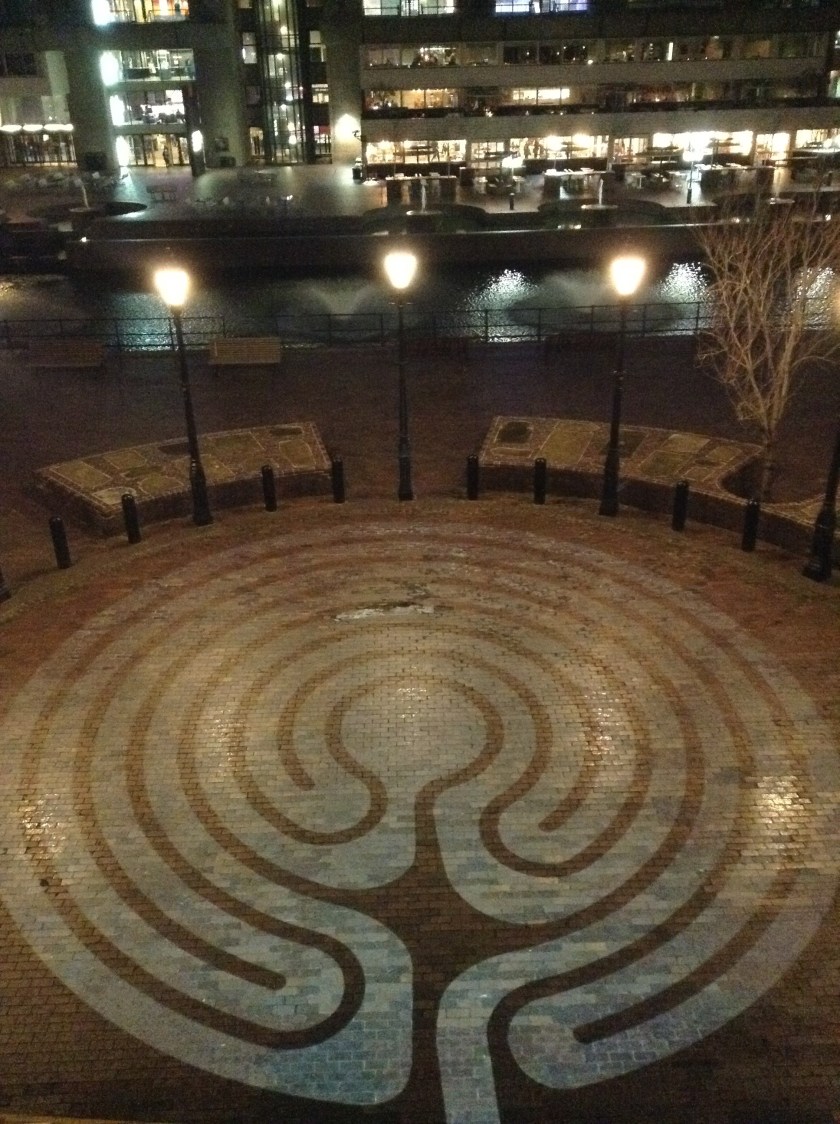
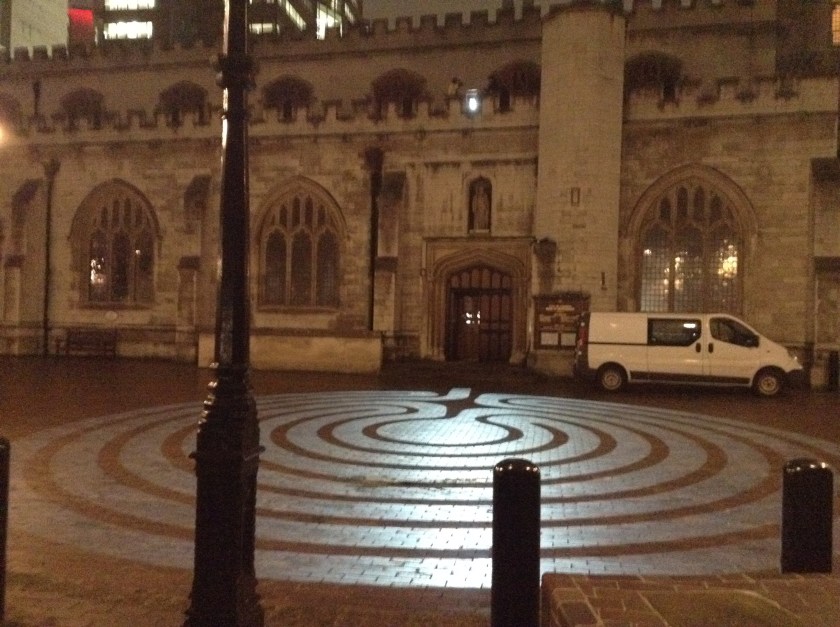
There is good news for anyone who hasn’t yet had the chance to nip down to see this stunning installation outside St Giles Cripplegate at the Barbican. Originally planned to last just over the period of Lent, Jim Buchanan’s glorious projection of a labyrinth of light from the roof of the church onto the old churchyard below will now stay in place for the next couple of weeks. So if you are in the area over the holiday period why not pop along one evening to enjoy it?
The labyrinth’s creator Jim Buchanan is a landscape artist based in Dumfries, Scotland and he is one of the world’s leading creators of labyrinths. Originally trained as a landscape architect, Jim has a particular interest in creating ephemeral labyrinths. He works internationally, using earth, water, ice and fire as well as light projection. This is the third time that Jim has created a light labyrinth for St Giles, but the first time it has been projected outside the church, where it now nestles into the space between the church and the City of London Girls’ School.
Eagle-eyed readers may notice that a detail from this installation is pictured on my website. Labyrinths have played quite a large part in my life since my partner developed a deep interest in all things labyrinthine some years ago. A quick glance round our living room reveals several labyrinth artefacts. On the mantelpiece alone I can see a small lace labyrinth, a photograph of a labyrinth made from sand on a beach and an invitation to a labyrinth gathering in Texas. Casting my eye around further, I spot the cover of the yellow paperback edition of Alain Robbe-Grillet’s Dans le labyrinth,an A1-size conference poster about labyrinth initiatives hiding unsuccessfully behind a chair, and a wooden chest in the window bay that contains plastic and wood finger labyrinths, a small fabric labyrinth and other bits of labyrinth kit.
Much of the last few days have been spent checking the index to my partner’s forthcoming book about … (yes, of course it is about labyrinths!) and so much in need of fresh air and exercise I set out for a long walk, but the labyrinth doesn’t let me go…
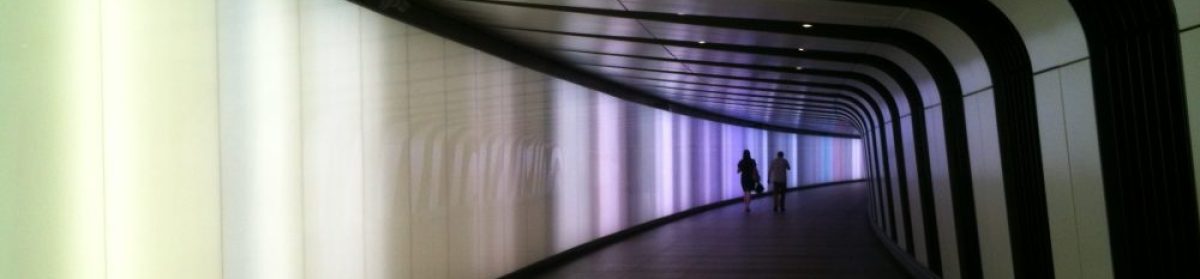
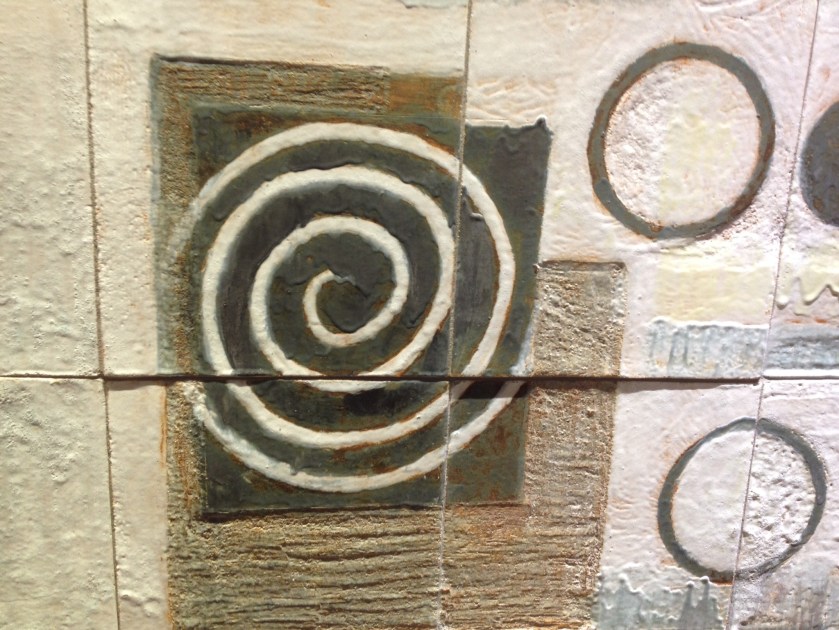
King’s Cross Labyrinth mural detail
Tucked away in the Regent Quarter between Caledonian Road, York Way and Pentonville Road; Phillip O’Reilly’s ceramic installation can be found on the wall of Varnishers Yard. The glazed tiles that make up the seven metre by seven metre mural were hand made in the artist’s Peckham studio and use images of local industry, films, novels and plants. So if you peer closely you might just make out trains, barges and local parks. The labyrinth is one of two Wall-Works commissioned from O’Reilly by P&O Estates.
Fen Court
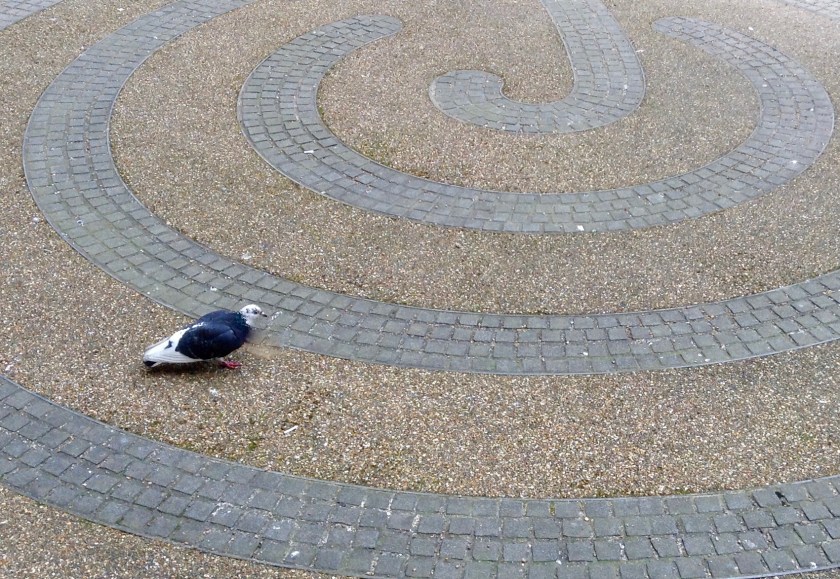
The labyrinth on Fen Court, just off Fenchurch Avenue in the City, aims to provide a space for quiet contemplation in the midst of the hustle and bustle of City life. Fen Court is the site of the old graveyard of St Gabriel Fenchurch, destroyed by the Great Fire in 1666 and never rebuilt.
Fen Court
Fen Court, EC3
Unlike many of the City’s squares and gardens, Fen Court is often far from tranquil. It is a busy thoroughfare with several doors opening onto it and smokers from nearby offices making good use of a strategically placed ash tray. Only at the weekend is it possible to get clear sight of the 5-circuit paved path and for a pigeon to enjoy the space undisturbed by human feet.
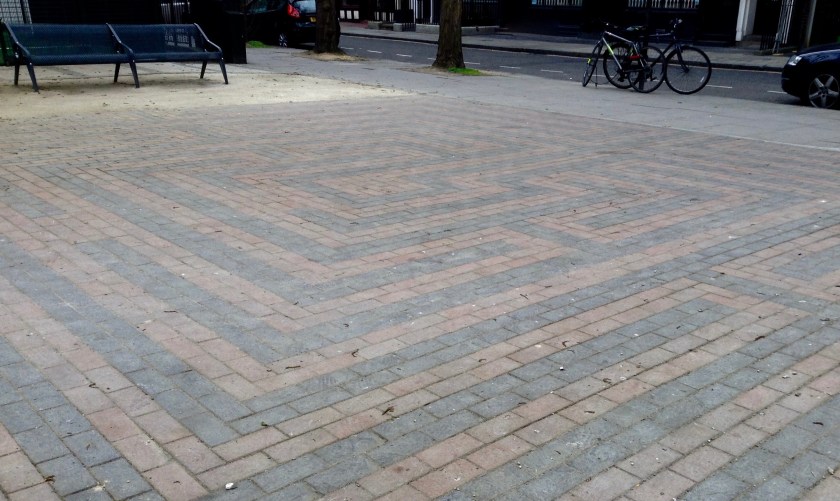
The labyrinth in front of the entrance to The Warren Playground on Whitfield Street in Fitzrovia is also paved and not especially conspicuous. Indeed I had stood on it more than once without realising that the pattern of the pavers at my feet was a labyrinth.
The Warren Playground Labyrinth
As with Fen Court it is not ideally suited to the contemplative walker as it provides the link between road and playground, but it is a good size for children to race around its square seven-circuit path based on a medieval pattern. Presumably the existence of a labyrinth and the name of the playground both play homage to nearby Warren Street.
Warren Street tile motif
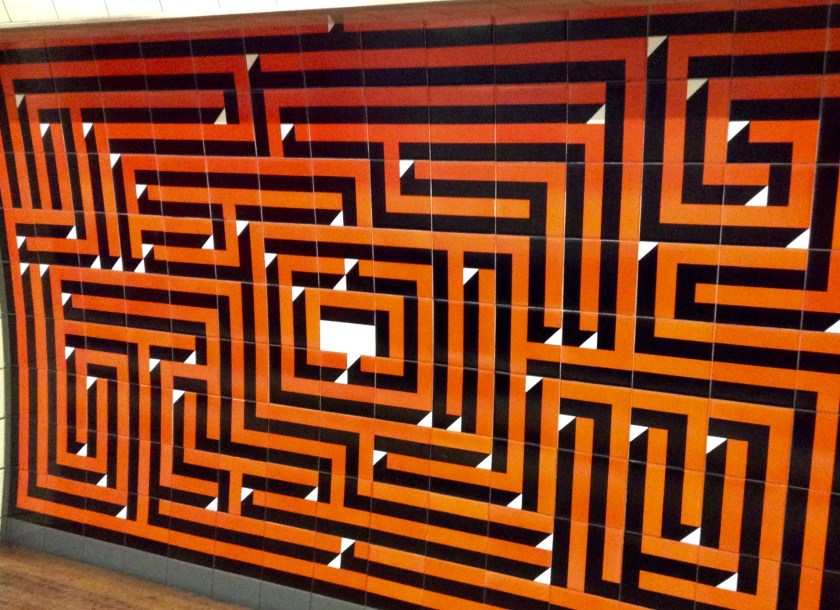
The tiling on the Victoria Line platforms of Warren Street station depicts a warren. Not the single twisting, turning, though essentially unimpeded path of the labyrinth, but the tricks and dead ends of a maze – designed to confound. I’ve always enjoyed the bold pattern and bright colours of these tiles, but the link is erroneous as Warren Street takes it’s name from Anne Warren, wife of Charles Fitzroy, first Baron Southampton who laid out Warren Street’s houses in 1799.
Labyrinth at Warren Street
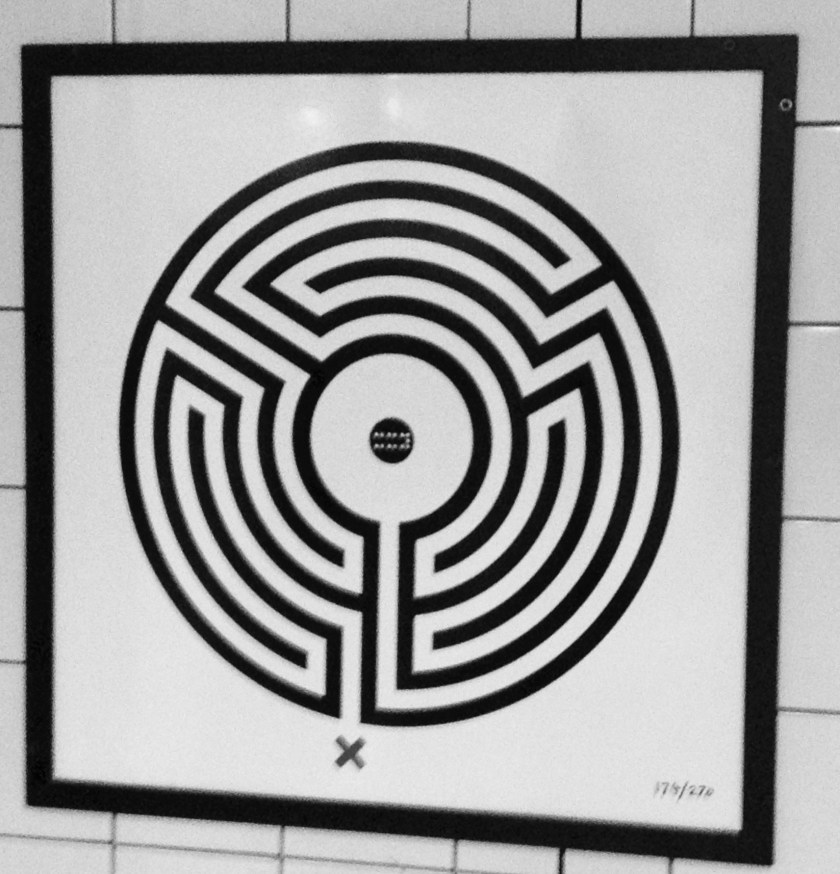
Though of course there is a labyrinth on this as on all tube stations – part of Labyrinth, Mark Wallinger’s artwork celebrating the 150th anniversary of the Tube with 270 individual vitreous enamel artworks echoing the Tube’s roundel logo.
Labyrinth of Light – St Giles Cripplegate
Not all labyrinths are permanent, nor can all be seen during the day. One of London most impressive labyrinths of the last few weeks has been landscape artist, Jim Buchanan’s stunning Labyrinth of Light cast onto the ground in front of St Giles Cripplegate and overlooked by the Barbican Centre across the water.
Installing the light labyrinth
The pattern is projected from the roof of St Giles Cripplegate each evening between dusk and about 10pm. But if you want to see it you need to hurry, as the installation is only for Lent and will finish on Wednesday 23rd March.
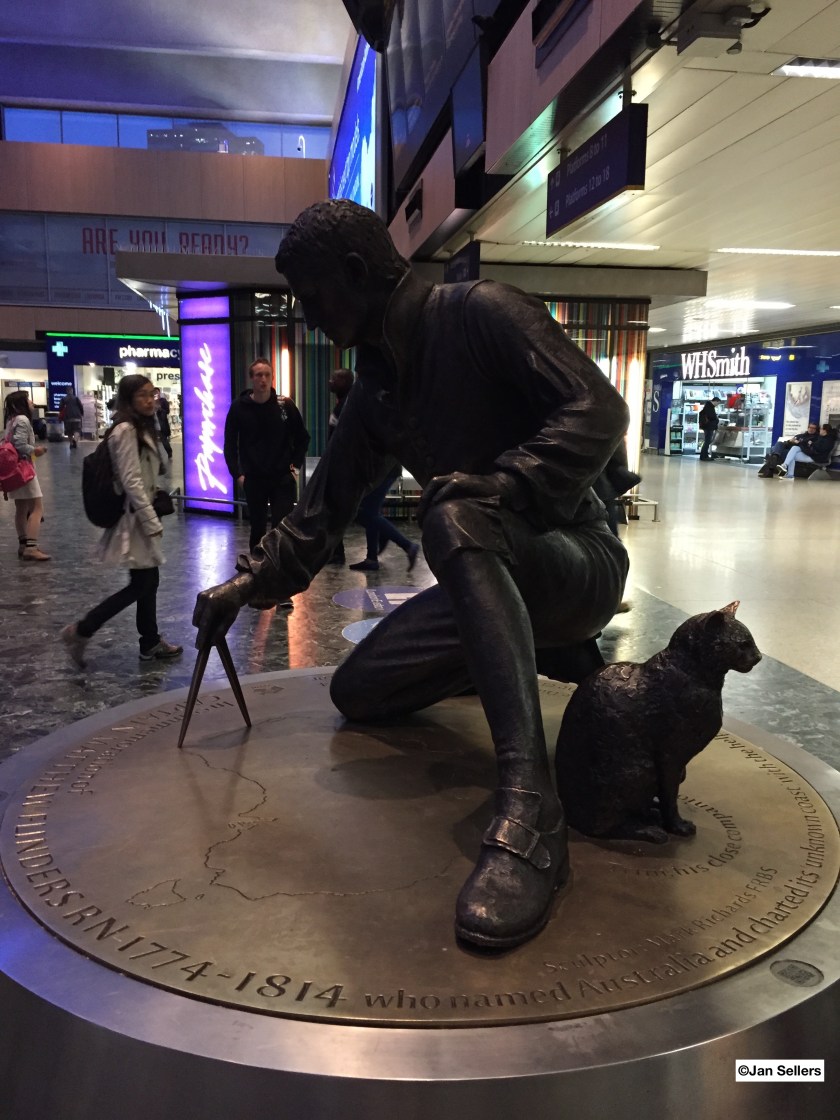
Mark Richards’ bronze statue of Matthew Flinders has been on the concourse of Euston station for almost two years but seldom gets the attention it deserves. Much of the time it is almost hidden among passengers waiting for trains who hardly notice what they rest their coffee cup on or where they perch to eat a sandwich and send a text message. The modern traveller’s concentration on our contemporary tools of navigation and communication is mirrored by the statue. Matthew Flinders looks down, dividers in hand, concentrating only on his charts and making calculations with the tools of his own time.
Later in the evening, when the crowds have died away and the rubbish has been cleared, Captain Flinders and Trim, his feline companion, are still hard at work. But now we can see what the work is. The chart is Australia. Although Flinders is not well known in his native country, his name (and that of his cat) are household words in Australia.
Matthew Flinders was a Lincolnshire lad, born on 16th March 1774. He went to sea with the Navy at 15, sailed with Captain Bligh to Tahiti and became a passionate and talented cartographer. Flinders made three voyages to the Southern Ocean. On the second, with his friend and colleague George Bass, he discovered that Van Diemen’s Land (Tasmania) was a separate island rather than part of the mainland. On the third he became the first person to circumnavigate the Australia and to identify it as a continent. In fact we owe the name Australia to Matthew Flinders who was the first to apply it specifically to the continent and who popularised it in his book Voyage to Terra Australis.
Returning home from his final voyage, Flinders became caught up in the wars between France and England, was arrested as a spy and detained in Ile de France (Mauritius) for more than six years.
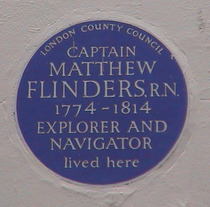
52 Fitzroy Street
During this time he was able to make notes for Voyage to Terra Australis and on his return in 1810 he settled in London, renting rooms in Soho and Fitzrovia to afford the access to the Admiralty and to his patron Sir Joseph Banks that he needed in order to complete his book and an atlas of his maps. London was expensive; he did not receive the promotion he hoped for and was living on half pay. His health was poor and he lived only another four years, just long enough to see publication of his book and dying at the age of forty.
Books seem to have played a large part in Matthew Flinders’ life, and he clearly made time for fiction. As a boy, he had been inspired to seek a Naval career after reading the adventures of Robinson Crusoe. Trim the cat was named after Uncle Toby’s manservant in Tristram Shandy on account of his ‘great fidelity and affection’. Trim was a ship’s cat born in the South Seas. He circumnavigated Australia, survived shipwreck and was the subject of a biographical tribute written by Flinders when he was detained in Mauritius.
But what are Flinders and Trim doing on Euston Station? Sadly, the answer relates to Matthew Flinders’ death. When Flinders died he was buried at St James Church, Hampstead Road, London. When the burial ground was closed to burials in the mid-nineteenth century and later opened as a public garden, part of the land was lost to the development of the railway. It is said that Matthew Flinders’ final resting place may lie beneath what is now platforms 12-15 of Euston Station.
Something of Matthew Flinders’ flair and methodological approach seems to have passed down the generations. Matthew’s only child Anne, was the mother of Flinders Petrie, the pioneering Egyptologist whose extensive collection of Egyptian antiquities now resides a stone’s throw from Euston in UCL’s Petrie Museum of Egyptian Archaeology. Petrie’s brain (and head), deposited with the Royal College of Surgeons in nearby Lincoln’s Inn Fields, were reputedly brought back by his widow in a hatbox from Jerusalem where his body is buried.
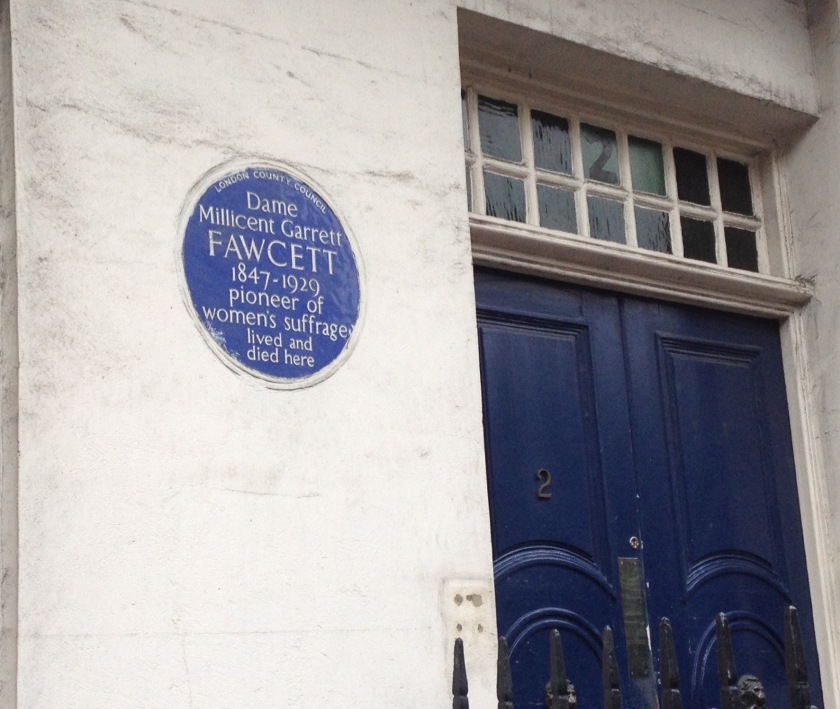
Just up from the Georgian charms of Bedford Square and around the corner from the swish new World Conservation & Exhibition Centre of the British Museum, the number 73 bus rumbles down Gower Street and on into Bloomsbury Street. As it stops at the lights, an observant passenger might spot the blue London County Council plaque to the left of the matching blue door of number 2 Gower Street.
Behind this door between the 1870s to the 1930s, four women of one remarkable family were making their mark upon the world though only one, Millicent Garrett Fawcett, is named on the plaque. So how did it begin?
Apparently, her mother Louisa told this story of how two of her daughters decided upon their careers. One evening at the family home in Aldeburgh, Suffolk, Elizabeth and Milly and Elizabeth’s friend Emily were brushing their hair by the fire, discussing the inequalities facing women and what they might do to advance women’s cause. Emily (aged 29) said women needed an education and she would open the universities to women, Elizabeth (aged 23) argued that women also needed an income so she would open up the professions, starting with medicine, and Milly (aged 13) was allocated the task of winning the Parliamentary vote. (Emily Davies co-founded Girton College Cambridge.)
Millicent Garrett Fawcett, who did indeed go on to lead the constitutional campaign for women’s suffrage, has long been one of my heroes. Her peaceful and persistent campaigning for women to get the vote began almost fifty years earlier than the direct violent action of the Women’s Political and Social Union (WSPU) sographically depicted in last autumn’s film Suffragette. The National Union of Women’s Suffrage Societies (NUWSS), of which Millicent became President, continued to campaign for gender equality in different guises and, now as The Fawcett Society, celebrates its 150th anniversary this year.
Elizabeth Garrett Anderson Hospital – now part of Unison Euston Road
Millicent’s older sister Elizabeth Garrett Anderson didn’t live in Gower Street but she did open up the medical profession. Elizabeth Garrett, became the first woman to qualify as a physician in Britain. She went on to found the New Hospital for Women (later the Elizabeth Garrett Anderson Hospital), was Dean of the London School of Medicine for Women and the first woman in Britain to be elected Mayor when she was elected Mayor of Aldeburgh, Suffolk in 1908.
Part of the Elizabeth Garrett Anderson hospital building is now incorporated into the offices of the trade union Unison and houses the Elizabeth Garrett Anderson Gallery
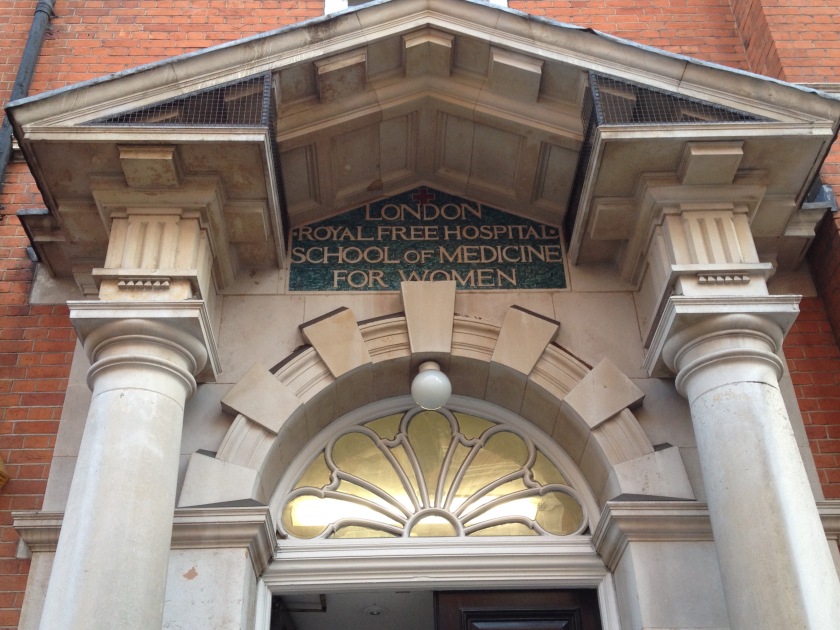
London School of Medicine for Women
Elizabeth’s daughter, Louisa Garrett Anderson, trained as a doctor at the London School of Medicine for Women and in 1915 established the Endell Street Military Hospital with her companion Dr Flora Murray.
From the 1870s, long before Millicent moved in, No 2 Gower Street was the home and workplace of the firm ofA&R Garrett House Decorators.A&R were the architectural decorators Agnes and Rhoda , (sister and cousin of Millicent and Elizabeth) and strictly speaking, the neat brass plate on the door that advertised their business contravened the terms of their Bedford Estate lease.
After a formal apprenticeship with the architect John McKean Brydon (who designed the Elizabeth Garrett Anderson Hospital and the London School of Medicine for Women) the two cousins became the first women professional house decorators, They designed carpets, textiles, furniture and wallpaper, exhibited in Paris and published a design book that ran to several editions. The composer Sir Hubert Parry employed them and they successfully tendered for interior design of the New Hospital for Women.
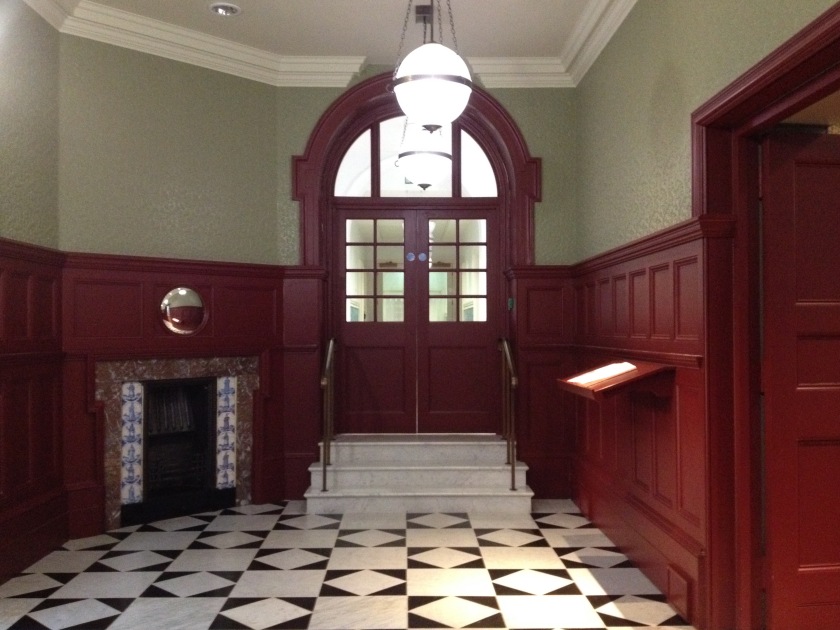
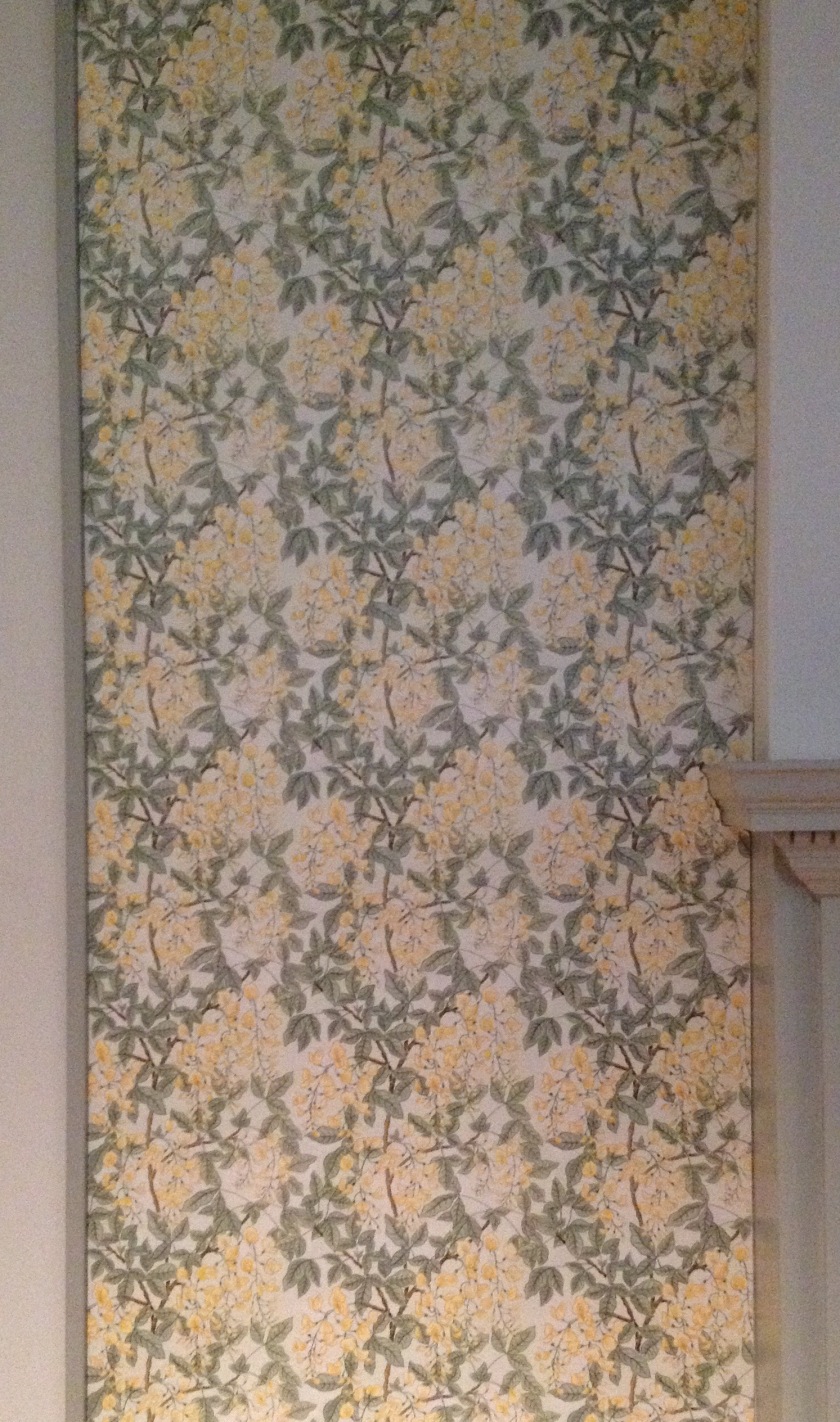
Garrett ‘Laburnum’ WallpaperFireplace by Agnes Garrett
Millicent moved in with her sister Agnes in the 1880s after the death of her husband, the academic and Liberal MP Henry Fawcett and their cousin Rhoda. Millicent’s daughter Phillippa Fawcett lived here and from here set off for Newnham College (of which her mother had been one of the founders) where she made history and newspaper headlines with her success in the mathematics finals, when she was placed “above the senior wrangler”. In plain English, she was better than any of the men!
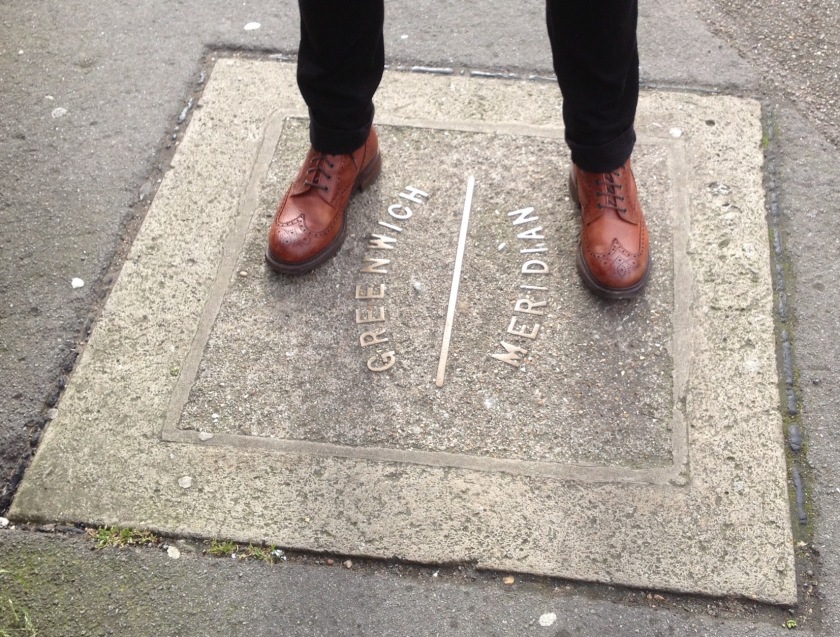
When I moved into the east London house in which I live, I was intrigued to discover in a nearby street a concrete paving slab with a neat brass inlay marking the line of the Greenwich Meridian. Twenty years later, I still take pleasure making sure I have a foot in each hemisphere as I cross the Prime Meridian. Though the elegantly shod feet in the picture above are not mine but belong to my friend JSF!
The Greenwich Meridian is the imaginary line of longitude that divides the globe into east and west, as the Equator divides it south from north. The Meridian passes from Pole to Pole through England, France, Spain, Algeria, Mali, Burkina Faso, Togo, Ghana and Antarctica. Each year, many thousand visitors from all over the world visit the Royal Observatory at Greenwich, and most take the opportunity of a photograph astride the Line. By contrast, very few people seem to take much notice of the many, varied and freely accessible Meridian markers elsewhere.
My local borough of Waltham Forest has perhaps been more diligent than many in marking the presence of the line.
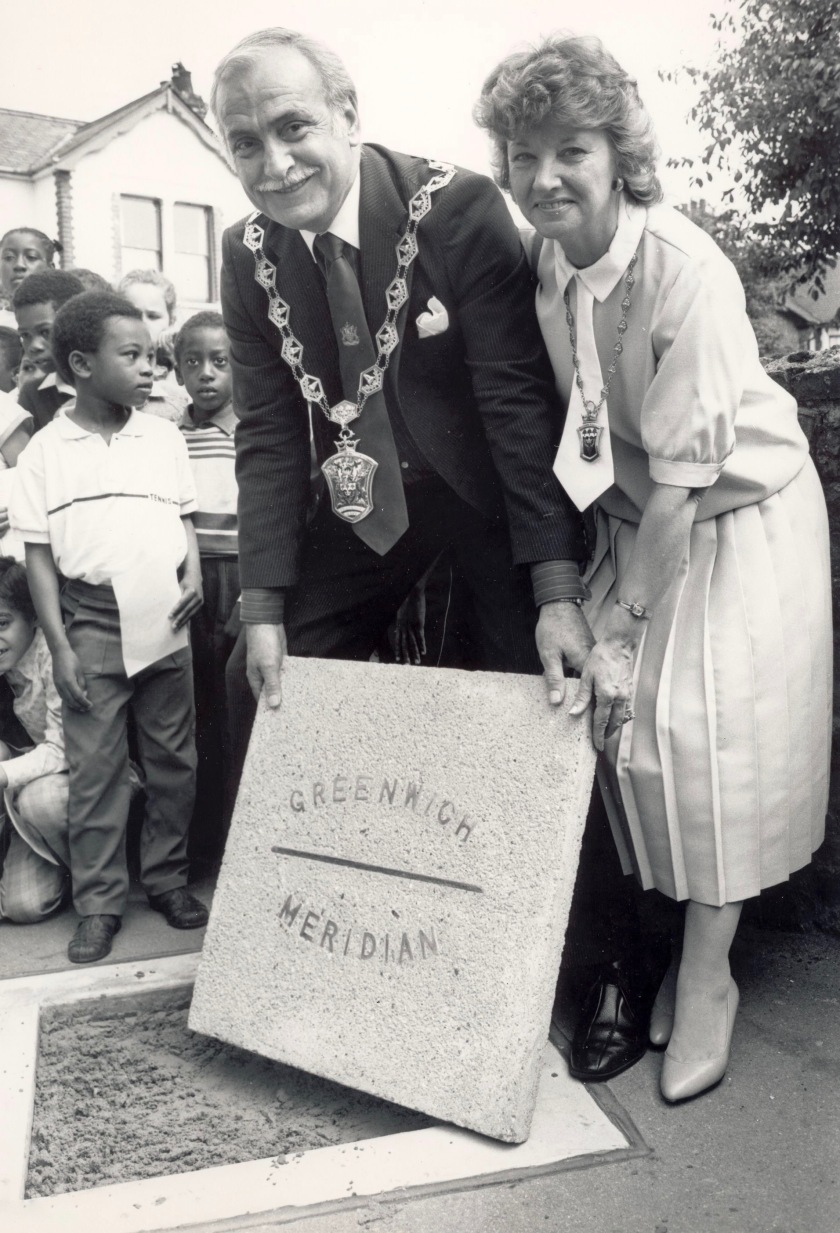
Mayor Cllr Derek Arnold with Essex Road Meridian plaque
The discreet brass plaque in Leyton that captured my imagination dates back to 26th June 1984, and is one of several installed by the borough of Waltham Forest to mark Meridian Day. This commemorated one hundred years since the International Meridian Conference, held in Washington DC in 1884, which agreed to adopt the meridian line that passed through the Principal Transit Instrument at Greenwich as the Prime Meridian.
Nationally, commemorative stamps were issued by the Royal Mail, the Duke of Edinburgh planted a tree and the Red Arrows flew up the Line. More locally, the Mayor of Waltham Forest installed the plaque here in Leyton.
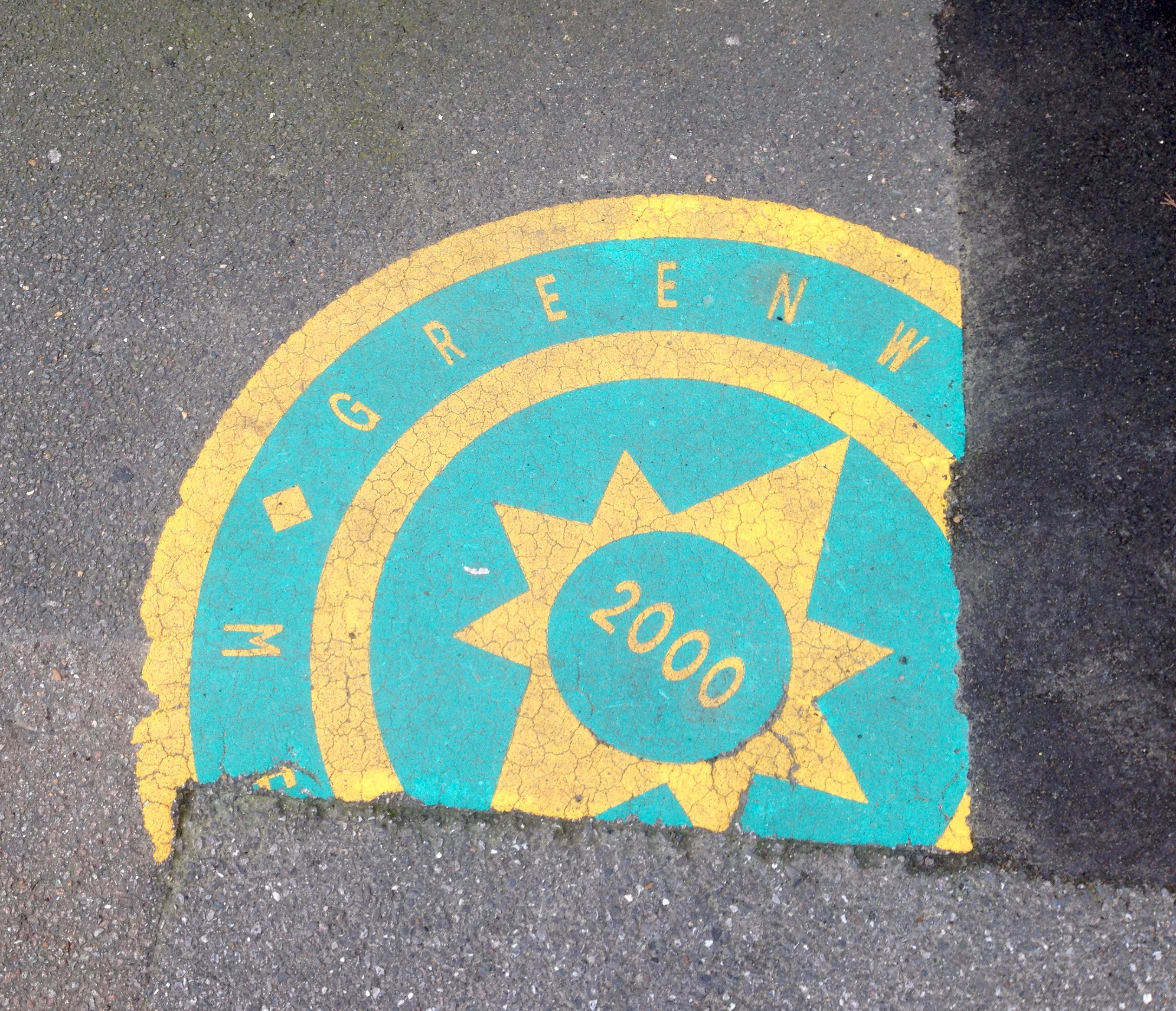
Millennium Marker Colchester Road, Leyton E10
Sixteen years later style and taste had changed. The Millennium year of 2000 saw a rash of green and yellow compass roses pop up on every street in Waltham Forest crossed by the Meridian. Apparently designed to last only for the year, there was no planned programme to remove them, and those that have survived the wear and tear of the last sixteen years now look rather sorry for themselves.
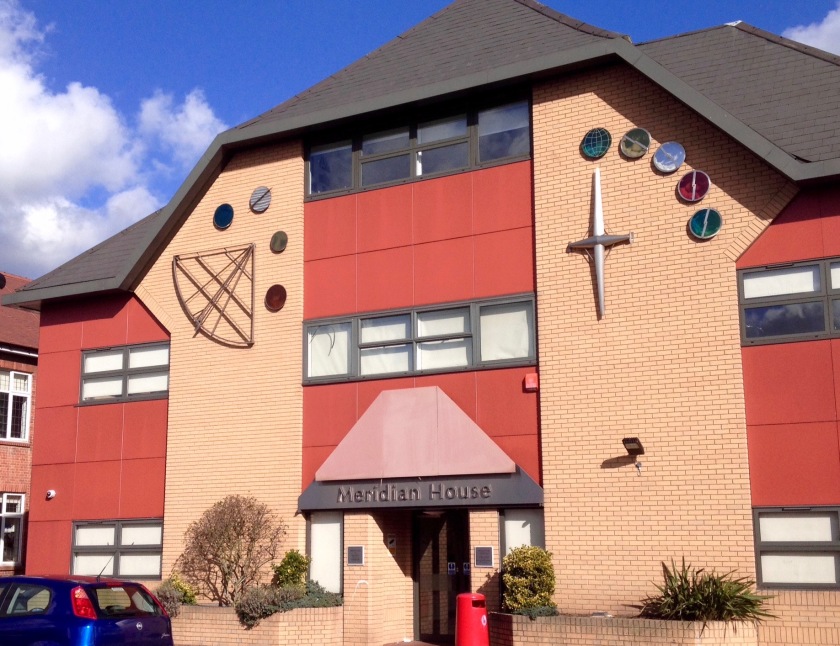
Leyton Sixth Form College – Meridian House
Very close to the two plaques above, the Line passes through the aptly named Meridian House, part of Leyton Sixth Form College, and decorated with fine representations of two Greenwich observatory instruments on the front wall. The one on the left is Hooke’s ten foot Mural Quadrant of 1676, on the right, Troughton’s 10-foot Transit Instrument, which defined the Greenwich Meridian from 1816–50.
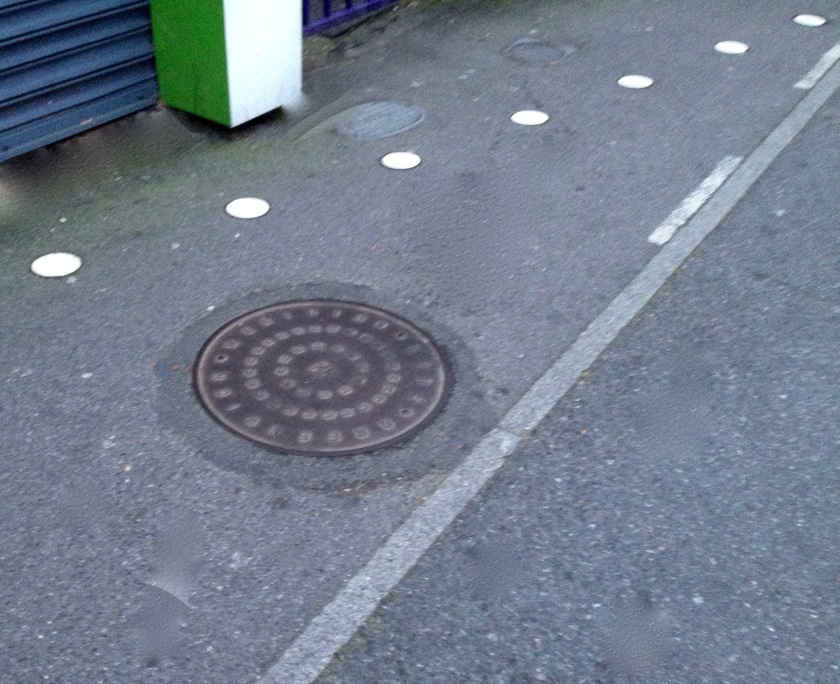
Prime Meridian Marker Wood Street E17
Pleasingly, the borough seems to have decided to return to a more durable and elegant style of marker than the green and yellow compass roses. Last year new permanent markers started to appear comprising a cast metal pavement plaque alongside a line of white stone studs.
Meridian Markers, Pole Hill
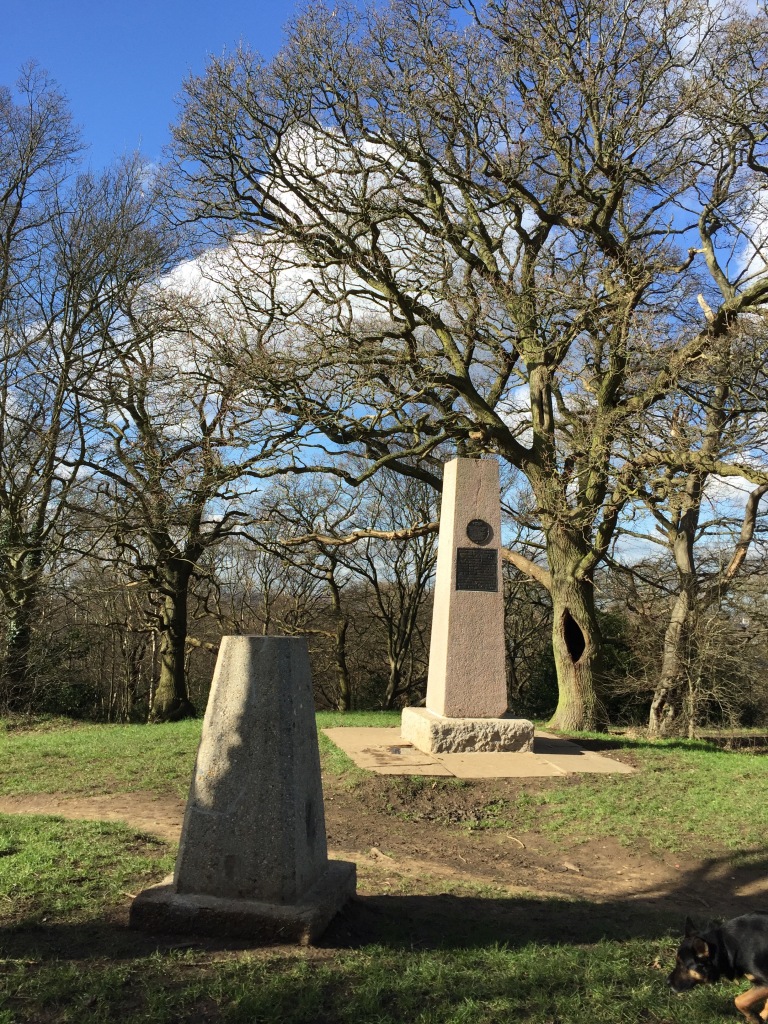
Not all the markers in Waltham Forest are purely decorative. Pole Hill in Chingford, eleven miles north of the Observatory at Greenwich, was a convenient point for a reference marker to check that the main telescope really was pointing due north. And in 1824, John Pond, the Royal Astronomer at the time, built the taller of these two stone pillars to provide an alignment check for the Greenwich telescope.
Inscription on Meridian Pillar, Pole Hill
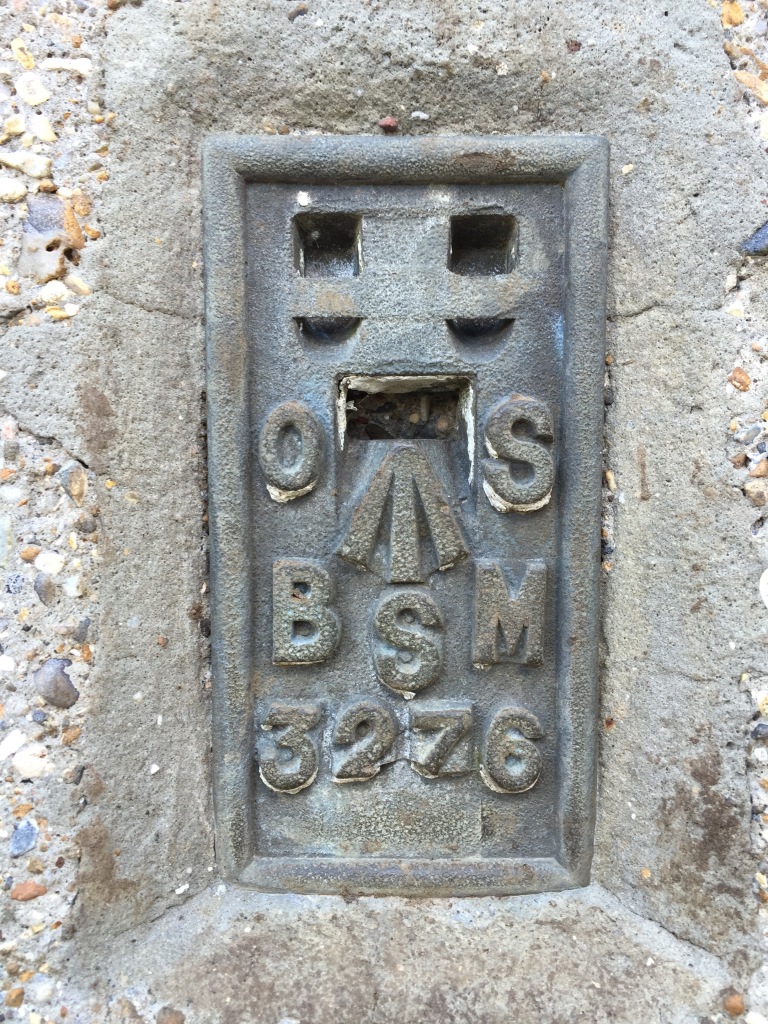
Extraordinarily, the smaller pillar on Pole Hill (an Ordnance Survey Trig. Point) is still used by the Observatory, but not to align the telescope. Instead it is the point from which Observatory staff check the green beam of the Millennium Laser that has blazed out across London’s night sky from the Old Observatory Building at Greenwich since midnight 31st December 1999. So, if on a clear night, you see a wobble in the laser beam, it might not be anything wrong with your eyes. It may just be that someone from the Observatory is checking with a colleague at Pole Hill that the beam is still correctly aligned and accurately illuminating the Prime Meridian for many miles.
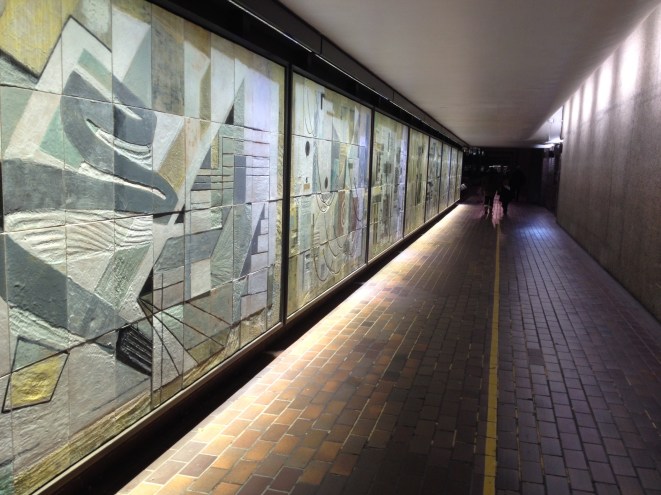
Much as I love the Barbican it can seem pretty bleak, especially in the late afternoon of a grey February day. So it is always a pleasure to plan a route to the library that takes me past Dorothy Annan’s joyful celebration of British technology in the 1960s.
Dorothy Annan Mural Speed Highwalk, Barbican London
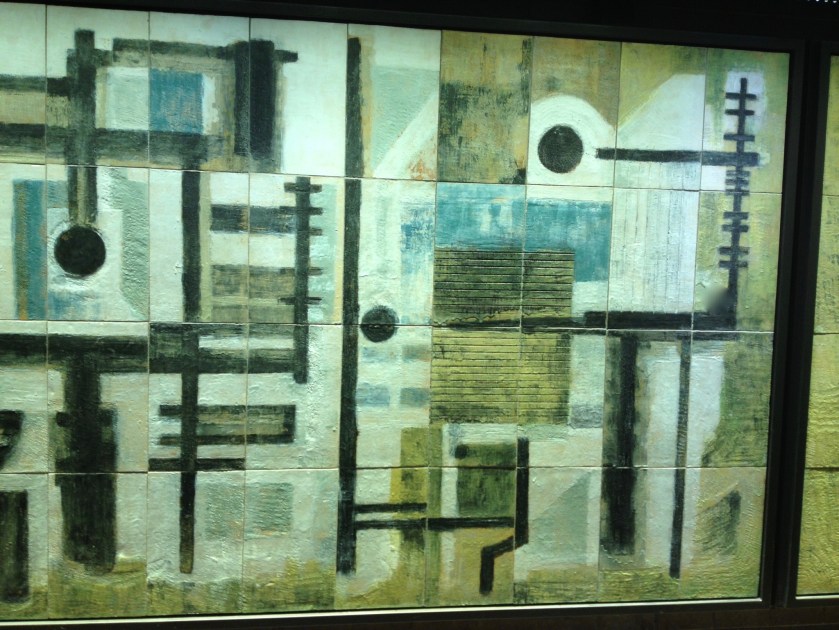
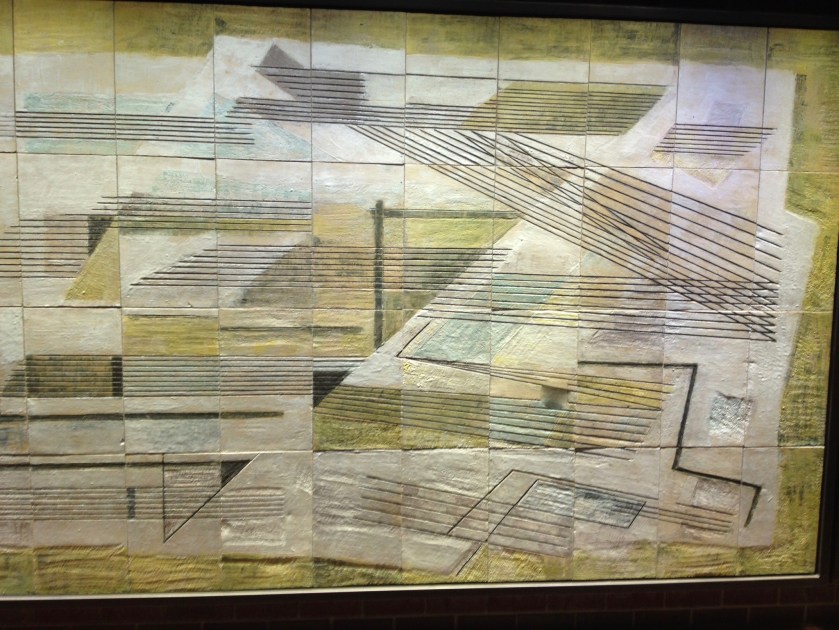
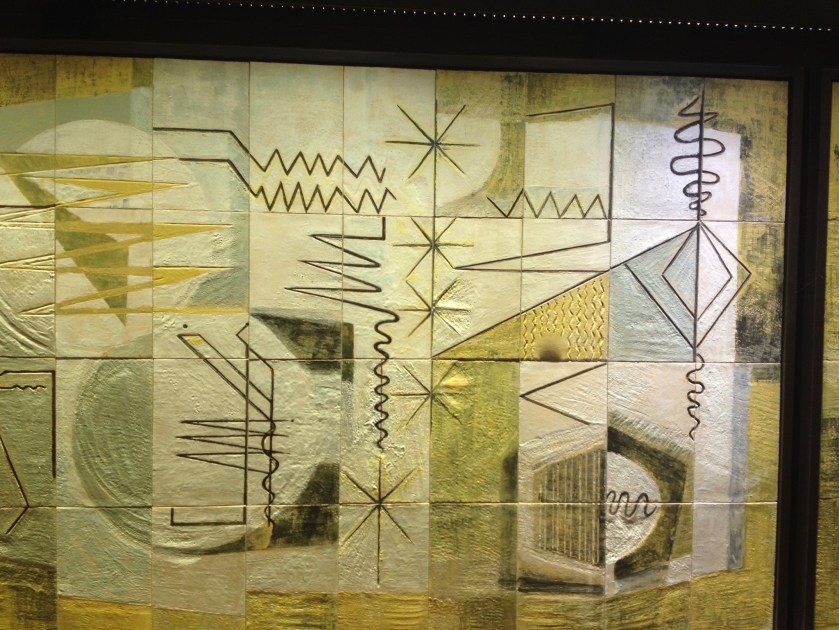
Now to be found on the Speed Highwalk between Speed House and the Barbican Centre, these nine beautifully crafted ceramic panels celebrate the “white heat” of 1960s communications technology.
Radio Communications & Television
The murals were commissioned in 1960 (at £300 a panel) by the Ministry of Public Building and Works to “add interest at street level” to the Farringdon Street side of the Fleet Building. So named because of the subterranean River Fleet flowing beneath, the thirteen-storey glass and concrete block was built to house the Central Telegraph Office. Designed under the supervision of the GPO’s Chief Architect Eric Bedford (who later designed the longer-lasting Post Office (now BT) Tower) this was London’s largest telephone exchange boasting 12,000 subscriber lines and employing 600 staff.
Dorothy Annan took her inspiration from the new communications technology. She researched her subject thoroughly, visiting Post Office buildings across London and photographing physical elements of the new technology to incorporate into her designs.
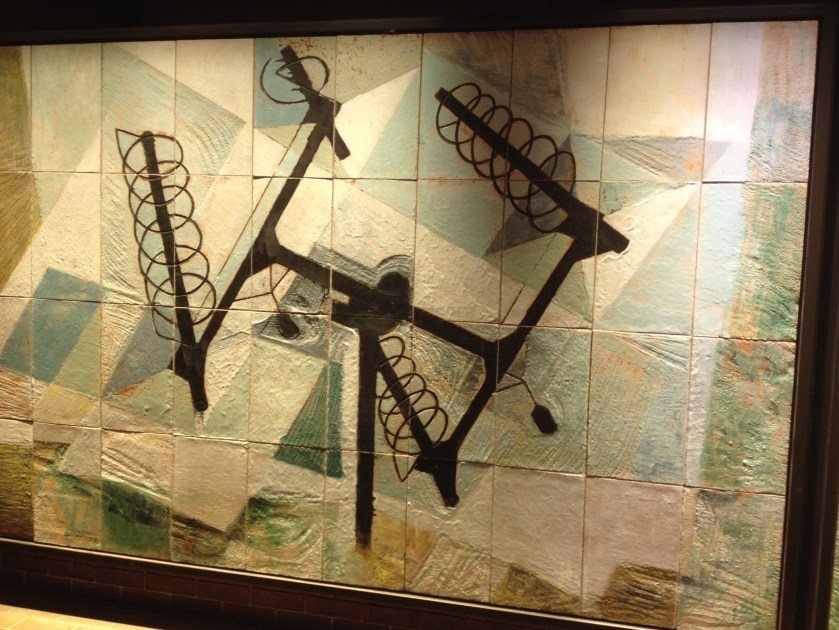
Power and Generators
The stylised and abstract panels representing the hardware of communications technology at the cutting edge: cables, pylons, aerials, generators, power lines, is softened by the muted colour palette.
Lines over the Countryside
Each one of the nine panels is a unique work of art and the influence of her contemporaries including Ben Nicholson, Paul Klee and Joan Miro is evident.
Impressions derived from the Patterns Produced by Cathode Ray Oscilligraphs used in Testing
The panels are each made up of forty biscuit-ware tiles, each roughly thirty by forty-six centimetres and manufactured by Hathernware Ltd of Loughborough. Dorothy Annan hand scored each of the 360 wet clay tiles to her own design in the Hathernware studios and, after the first firing, she decorated, glazed and fired them in her own London studio.
Detail from Cable Chamber with Cables Entering
Dorothy Annan (1908-1983) was a ceramist and a painter and is now best known for her murals. Politically left-wing, she was a member of the Artists International Association (along with Paul Nash, Ben Nicholson and Frank Auerbach) whose aim was the “unity of artists for peace, democracy and cultural development. The AIA saw travelling exhibitions and murals as a means of promoting wider access to art. Many functional and utilitarian post-war public buildings like the Fleet Building were brightened up by murals.
Overseas Communication showing cable buoys
Sadly very few survive, Dorothy Annan’s largest work, Expanding Universe at the Bank of England was destroyed in 1997. Her only other surviving work in London – a London County Council commission for Caley Street school in Tower Hamlets – was happily rediscovered in 2008. The Fleet Building mural was heading for the same fate. The building had been in a state of near dereliction for many years after computerisation superseded telegraph and Telex, and Goldman Sachs – who had acquired the site to build their new £350m European HQ – did not initially see merit in the work.
But thanks to a campaign by 20th Century Society and Tile and Architectural Ceramics Society among others, the mural (though not the building to which it was affixed) was awarded Grade II listing by English Heritage in 2011. In 2013, with agreement of the Corporation of the City of London and a dowry of £100,000 from Goldman Sachs the panels were relocated to Speed Highwalk preserving them for posterity and “adding interest” at highwalk level.
Everyone has a story. Oonagh Gay may have retired in June 2015 from running the Parliament & Constitution Centre, which she set up at the House of Commons Library 15 years ago, but she’s now able to focus on her passion for local history and run some great weekend walks – many starting in Islington. Interview by Nicola Baird
Oonagh Gay runs weekend walking tours – several start in Islington. Try her Stroud Green walk, or Angel or Holloway Road. Info at crouchendwalks and inspiring london walks.
Oonagh Gay, OBE, claims she’s always been immersed in local history. Her father Ken Gay, who recently died aged 91, was president of the Hornsey Historical Society and had a huge local history collection. “We’ve just had to clear 11,000 books,” says Oonagh surprisingly calmly considering she’s spent the past two years winding up the job she’s had for 30 years, packing up and selling her…
Pioneers, Poets & Pacifists in Bloomsbury – Thursday 19th May 11:00 am
On this stroll though Bloomsbury squares we meet ten of the lesser known women who played a significant role in science, medicine, politics, the arts. They include the distinguished scientist imprisoned as a conscientious objector, the first woman to gain a Master of Surgery degree, the novelist who championed education for disabled children but opposed women’s suffrage, and more…
Now that the days are longer and the evenings lighter Third Thursday Walks shift to the evening
The ‘New Woman’ in East Bloomsbury – Thursday 16th June 6:30 pm
Follow in the footsteps of some of the pioneers of women’s education, employment and suffrage. On this walk through east Bloomsbury’s quiet streets and squares we will see where the first women Doctors trained, discover the Rational Dress Society and why it was needed, meet the advertising copywriter who became a famous detective writer, the activist who established a women-run printing press and much more. This is a circular walk from Russell Square tube.
Clowning about in Clerkenwell – Thursday 21st July 6:30 pm
This two-hour walk centres on Joseph Grimaldi, the most celebrated English Clown, who lived, worked and died in this historic area. Hear the extraordinary story of Joey’s life, loves and work as we stroll through an area long associated with entertainment and with the Italian community. We meet at Chancery Lane Station (north exit – Grays Inn Road side) and finish in Joseph Grimaldi Park near Kings Cross.
Noor Inayat KhanChildren’s Author & WW2 SOE operative
On tomorrow’s stroll though Bloomsbury squares we meet ten of the lesser known women who played a significant role in science, medicine, politics, the arts. They include the distinguished scientist imprisoned as a conscientious objector, the first woman to gain a Master of Surgery degree, the novelist who championed education for disabled children but opposed women’s suffrage, and more…
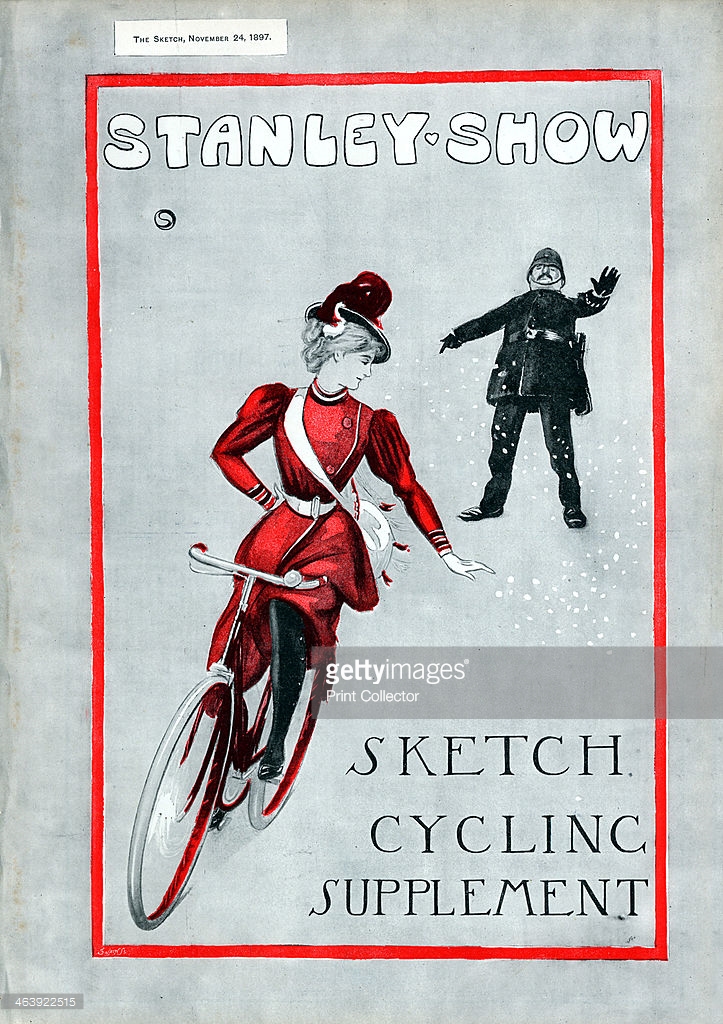
Meet the independent women of the late 1800s and early 1900s. Long before the Boris bike (though that should really be the Ken bike) the Rover safety bicycle offered new freedom to women as well as healthy outdoor exercise.
Fashion adapted to meet these new demands, introducing simpler more business-like styles.
In America, Amelia Bloomer gave her name to a particular form of comfortable clothing, while a few years later in the UK, the Rational Dress Society protested “against the introduction of any fashion in dress that either deforms the figure, impedes the movements of the body, or in any way tends to injure the health. It protests against the wearing of tightly-fitting corsets; of high-heeled shoes; of heavily-weighted skirts, as rendering healthy exercise almost impossible; and of all tie down cloaks or other garments impeding on the movements of the arms” .
Its members were more likely to advocate Dr Jaeger’s ‘sanitary’ woollen wear. Just the thing for the the aspiring doctor studying at the London School of Medicine for Women!
Join my walk on Saturday 16th January to discover Bloomsbury’s ‘New Women and they legacy they left behind.
 There is good news for anyone who hasn’t yet had the chance to nip down to see this stunning installation outside St Giles Cripplegate at the Barbican. Originally planned to last just over the period of Lent, Jim Buchanan’s glorious projection of a labyrinth of light from the roof of the church onto the old churchyard below will now stay in place for the next couple of weeks. So if you are in the area over the holiday period why not pop along one evening to enjoy it?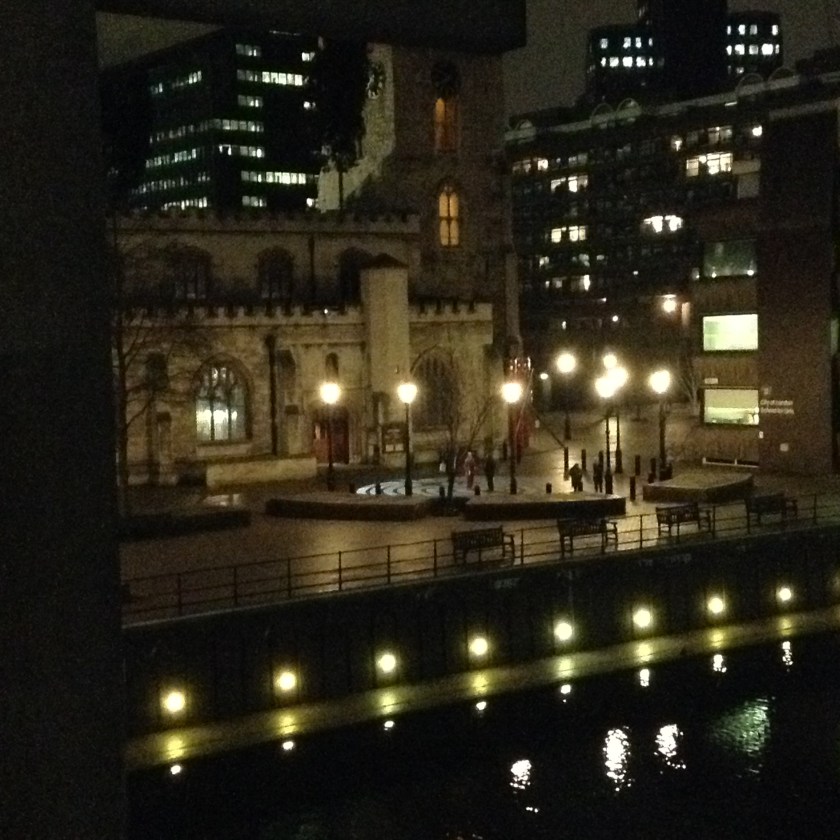











 Capital Walks in London